

In sixteen years at one church, I had two performance reviews.
Both were less than positive. And honestly, it wasn't about me. Frustration had been building in senior leadership for years. Nobody had given me feedback along the way. Then someone decided we needed to do reviews, and the review became the place to unload five to eight years of it, all at once.
You can imagine how that felt.
I carried that into my next organization, where reviews happened quarterly. (I wouldn't recommend that cadence, by the way. Once I became a manager, they came around with alarming regularity.) Before my first one, my boss asked how I was feeling about it. I admitted I was anxious. His favorite phrase was “tell me more about that,” so I did. I told him about those first two reviews.
Then he said something that changed how I lead: you should never walk into a review and be surprised.
I've never forgotten it.
The rule I won't break
I now hold one value about reviews as close as any I have. I refuse to bring anything into a review that we haven't already talked about.
It's tested me. I'll be writing a review and think, I should add this. Then I stop and ask myself, have we actually discussed it? When the answer is no, I pull it out and put it on the list for our next one-on-one. Every time.
Here's what I've come to believe: if a review contains a surprise, the system already failed. A concern that shows up on paper for the first time is a manager failure, not an employee failure. The review should be a summary of a conversation that has been happening all year.
I've grown to love performance reviews. That sounds strange, I know. But I believe the people who work with me care deeply about their work. They want to do it well. They deserve feedback, and giving it is my job.
What has made reviews work for me
I'm still learning, and I don't think anyone fully arrives on this. But a few things have held up across every team I've led.
Start with a plan. The employee and manager write the role, the values, and the goals together. Twelve months works for most teams. Six works for fast-moving ones. Quarterly is too much.
Make one-on-ones the center. Meet monthly at minimum, and more often for people who need more direction. If the conversation stays tactical, growth gets crowded out. In one organization I put separate quarterly check-ins on the calendar with a simple rule: no tactical topics at all.
Write things down. Without notes, recency bias takes over and the last two or three months swallow the whole year. A running doc for each person turns a painful review into an easy one.
Before you blame the employee
When someone struggles, leaders tend to jump to one conclusion: they won't do it. But there are five reasons people underperform, and the manager owns four of them.
They don't know what to do. Expectations are unclear.
They don't know how to do it. They lack training or tools.
Barriers stand in the way. Competing priorities, broken systems, or someone blocking them.
They won't. The only one that sits fully with the employee.
They can't. This usually traces back to a hiring or role-placement mistake.
Rule out the first three before you decide it's the fourth. Most of the time, the problem is ours.
Specific beats general
Picture a grid. One axis runs positive to negative. The other runs general to specific.
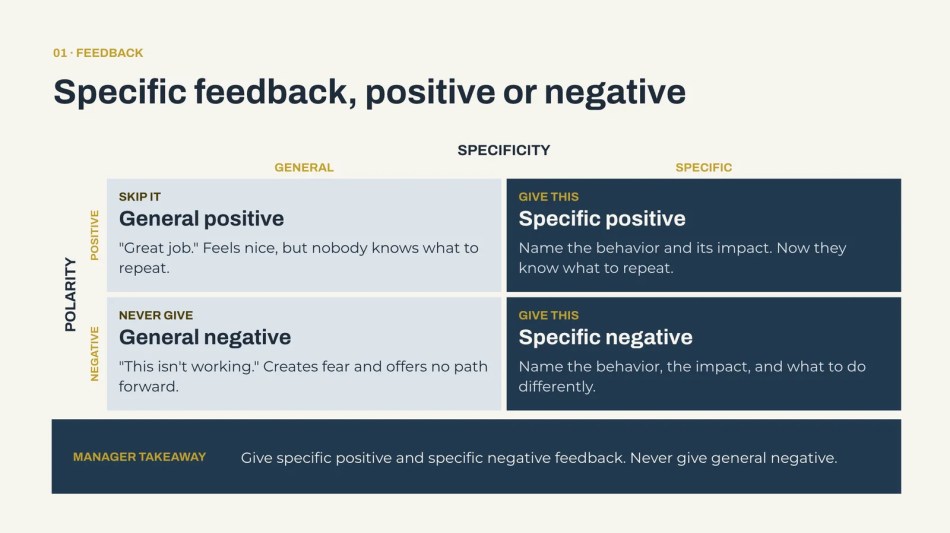
Specific positive feedback names the behavior and its impact, so the person knows what to repeat. Specific negative feedback names the behavior, names the impact, and says what to do differently. General praise is fine but weak. General criticism—“you need to be more of a team player”—should never happen. It breeds fear, offers no path forward, and erodes trust. I'd argue that one box is the root of most toxic cultures.
The review itself
Let the employee go first. Have them complete a self-assessment before they see anything from you. It surfaces growth areas and aspirations naturally, and it shows you how self-aware they are.
Then write your own assessment independently, drawing on your one-on-one notes. Cover achievements, values in action, growth areas, and aspirations. Aspirations belong to the employee. Your job is to show how you'll invest in them.
Finally, compare the two and talk about the gap. That difference is where the best conversation lives. Reality usually sits somewhere in the middle, and sometimes the employee points out something you genuinely missed. Adjust when they do.
Keep pay out of it. The moment a raise is on the table, people tune out everything else. Hold the development review first and have the compensation conversation a month or two later.
Four questions to ask yourself
- Do you have a consistent process for writing reviews?
- Do you have a consistent process for facilitating them?
- Would your team describe their roles the same way you would?
- Could each person on your team tell you what success in their role looks like?
Find the one that gets a “no.” Start there.
The goal isn't a better form. It's a team that never wonders where they stand.







0 Comments